AGV or AMR? A Clear Guide to Choosing the Right Mobile Robot
In today’s fast-evolving industrial landscape, mobile robots have become essential tools for improving productivity, reducing labor strain, and increasing operational efficiency. Two of the most common solutions are:
Automated Guided Vehicles (AGVs)
Autonomous Mobile Robots (AMRs)
While both are designed to move materials from point A to point B, they differ significantly in technology, flexibility, and ideal use cases. Choosing the right one depends on your operational needs, environment, and long-term strategy.
What Is an AGV?
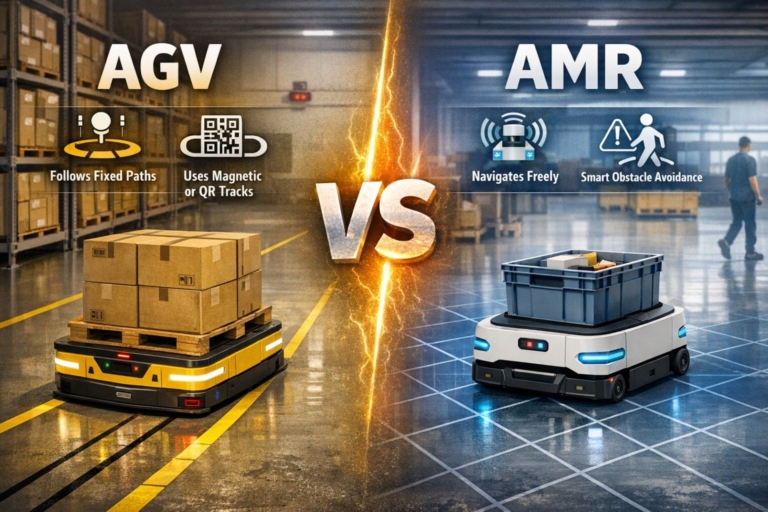
An AGV (Automated Guided Vehicle) follows a fixed, predefined path using guidance systems such as:
Magnetic strips
Floor tape
Embedded wires
Reflectors or QR markers
How does it work?
Moves along a set route
Stops if an obstacle blocks its path
Requires physical infrastructure changes to modify routes
What Is an AMR?
An AMR (Autonomous Mobile Robot) navigates independently using sensors, cameras, LiDAR, and AI. Instead of following a fixed line, it:
Maps its environment (SLAM technology)
Chooses the most efficient path
Avoids obstacles dynamically
Re-routes automatically
How does it work?
Uses real-time data and onboard intelligence
Makes decisions autonomously
Adapts to changing environments
In simple terms: AGV = A train on tracks AMR = A self-driving car
So, which one should you choose? Here are some factors to consider before choosing.
1. Layout Stability If your facility layout rarely changes, AGVs may be a cost-effective and reliable solution. If your operations evolve frequently, AMRs offer greater flexibility.
2. Scalability Adding new routes for AGVs can require infrastructure changes. AMRs can typically be scaled more easily through software adjustments.
3. Budget and ROI AGVs may have lower upfront intelligence costs but higher modification expenses over time. AMRs often require higher initial investment but can reduce long-term reconfiguration costs.
4. Operational Complexity Highly dynamic environments with mixed human traffic tend to benefit more from AMRs, thanks to their advanced obstacle avoidance capabilities.
Despite all this, there is no one-size-fits-all answer when deciding between AGVs and AMRs. Both technologies deliver significant value when aligned with the right operational needs.
If your priority is stability, repetition, and proven performance in a structured setting, AGVs remain a strong choice. If your business demands flexibility, scalability, and intelligent navigation in a changing environment, AMRs may be the better investment.
Ultimately, the best mobile robot is not the most advanced one. It’s the one that fits your workflow today while supporting your growth tomorrow.
Ready to Deploy AGVs or AMRs with Mirai?
Whether you’re optimising a stable production line or building a flexible, future-ready warehouse, Mirai helps you identify the right mobile robot solution for your operations. From feasibility assessment and layout planning to system integration and commissioning, we deliver end-to-end support tailored to your workflow.
Connect with Mirai today to explore how AGV or AMR integration can transform your material handling performance!