
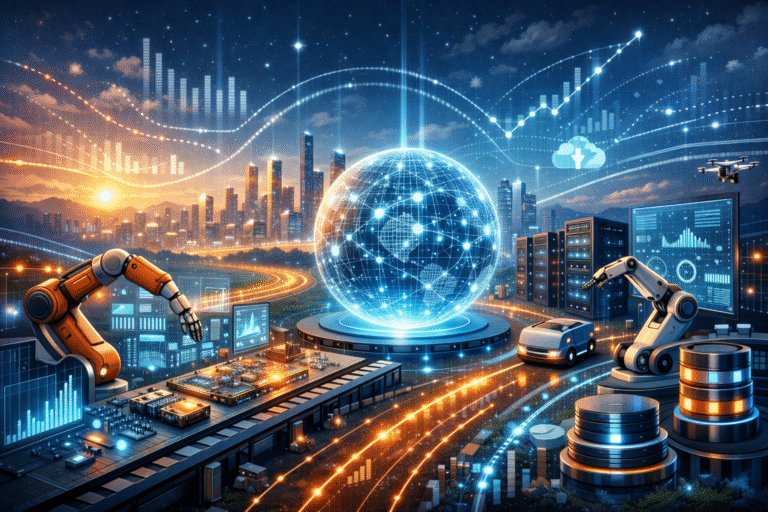
Automation is the use of technology to perform tasks automatically with minimal human involvement. It is commonly used by businesses to improve efficiency, reduce errors, and save time. While automation may sound complex, it usually follows a simple and logical flow:
Data input → Automation engine → Output
1 – Data Input
Every automation process starts with data input. This data can come from many sources, such as online forms, customer orders, sensors, emails, spreadsheets, or internal systems. The data provides the information needed for the automation to run.
At this stage, the system may also clean, validate, or organise the data to ensure it is accurate and usable. Good-quality input data is essential, as it directly affects how well the automation performs.
2 – Automation Engine
Once the data is collected, it moves into the automation engine, which is the core of the system. The automation engine follows predefined rules, workflows, or logic to process the data. It can make decisions, perform calculations, trigger actions, or route tasks automatically based on the conditions set.
In more advanced setups, the automation engine may also use AI or smart algorithms to analyse patterns and improve decision-making over time. This allows businesses to automate not just simple tasks, but also more complex processes.
3 – Output
After processing, the system produces an output. This output is the final result of the automation. It could be a report, an approved request, an updated database, a notification sent to a customer, or an action taken by a machine or system.
Because the process is automated, outputs are delivered faster and more consistently, helping businesses operate more smoothly and efficiently.
Why Automation Matters
By following the flow of data input → automation engine → output, automation reduces manual work, minimises human error, and frees up time for teams to focus on higher-value tasks like strategy and innovation.
Other Southeast Asian markets are also moving quickly
- Vietnam continues to attract high-tech manufacturers and is integrating automation into fast-growing industrial zones.
- Thailand is modernising its automotive and electronics sectors with robotics and intelligent production lines.
- Indonesia is ramping up automation in logistics, consumer goods, and export-driven industries.
This collective momentum is shifting perceptions of the region; from low-cost production to high-value, tech-enabled manufacturing.
Ready to Automate with Mirai?
If you’re looking to start or scale your automation journey, Mirai is here to help.We design and implement automation solutions tailored to your business needs, so your processes run smarter, faster, and more efficiently.
Get in touch with Mirai today and see how automation can transform your operations!